By rotating the ternary-3D plots, and provided that the diversity of samples is such that H and C are not implicitly correlated, alignment of data occurs at certain rotation angles, indicating a certain dependence on composition. By analytically fitting such alignment, the composition of SRC:H samples can be retrieved from the optical constants. All details in [1]
Click on the plots and rotate the ternary-3D plots yourself, to visually determine the best rotation angle. Identifying the best rotation angle is essential to determine the analytical dependence of optical properties on composition.
More on samples
The samples have been fabricated by very-high-frequency plasma-enhanced chemical vapor deposition.
The composition has been determined by Rutherford Back Scattering.
The optical constants have been retrieved by fitting the UV-Visible Reflectance and Transmittance (R&T) spectra by means of GTB-fit [2, 3]
The R&T spectra and the optical constant of all samples may be found in the supplementary material of [1]
References:
[1] C. Summonte, F. Gaspari, S. Quaranta, R. Rizzoli, E. Centurioni, M. Canino, A.Y. Polliotti, M. Bianconi, A. Desalvo, A Ternary–3D analysis of the optical properties of amorphous Hydrogenated Silicon–rich carbide, Mat. Chem. Phys. 2018, to be published. Available online via Science Direct.
[2] M.Allegrezza, F.Gaspari, M.Canino, M.Bellettato, A.Desalvo, C.Summonte, Tail absorption in the determination of optical constants of silicon rich carbides 556 (2014) 105-111; ibid. (E) 564 (2014) 426
[3] https://www.bo.imm.cnr.it/users/summonte/minuit/minuitfit.html
Ternary diagrams: Courtesy of highcharts.com to the UOIT
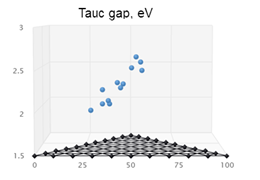
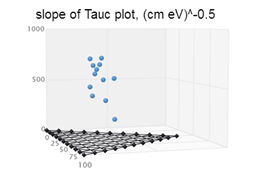
Tauc gap (eV), and slope of the Tauc plot (cm ev)-0.5, obtained by linearly interpolating the Tauc plot of the samples. The same Tauc gap is also introduced in the JTL-GB [2, 3] model as fixed parameter
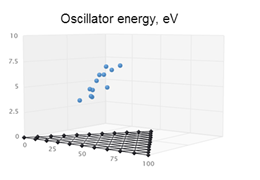
Oscillator energy, eV. This is the energy of the Jellison-Tauc-Lorentz-with-Gaussian-Band (JTL-GB) analytic form [2, 3] which is used to describe the optical constants of the material.
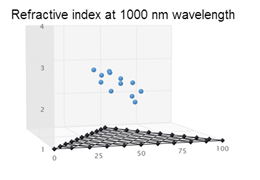
Refractive index at 1000 nm. It is assumed as representative of the refractive index at long wavelengths, which is appropriate for samples with optical gap of 2 eV and higher.
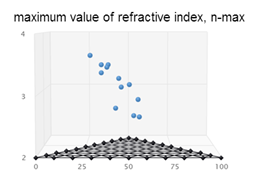
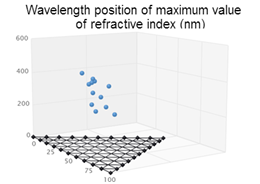
Maximum value of the refractive index, and its spectral position (nm). For semiconductors with optical gap of 2 eV and higher, the refractive index shows a maximum in the blue region of the spectrum, as described by the JTL-GB [2, 3] analytical form.